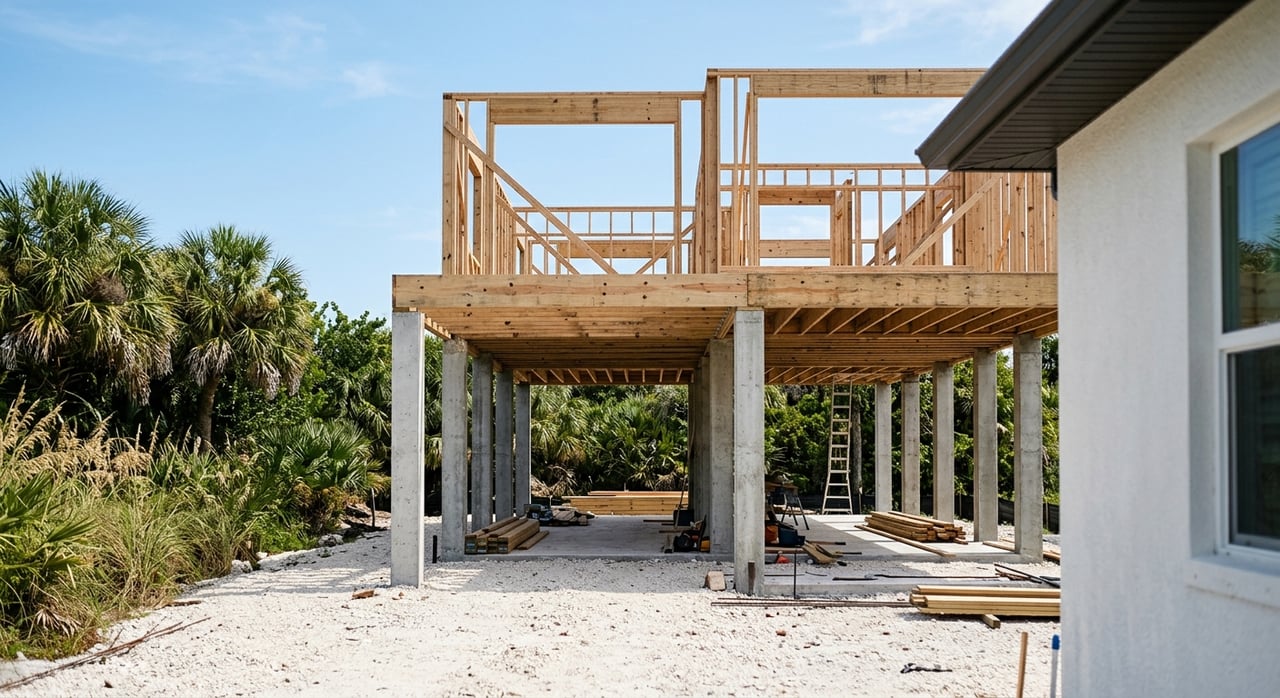
Thinking about building on Cudjoe Key? A vacant lot can look simple at first glance, but in the Lower Keys, the real story is in the details. If you want to avoid costly surprises, you need to understand lot feasibility, permit timing, flood requirements, and the local cost factors that can shape your project before you close. Let’s dive in.
On Cudjoe Key, the first question is not just whether a lot has an address. The bigger question is whether the parcel has the right mix of land-use, flood, and environmental characteristics to support a home.
Monroe County recommends checking the parcel in its GIS system using the RE or AK number. From there, you can review the Tier, zoning, FLUM, and FEMA flood-zone layers. This step helps you see whether the lot is in a category that may support residential construction or whether added constraints could affect your plans.
Monroe County uses a tier overlay system that plays a major role in buildability. Tier III generally covers infill lots in platted subdivisions with adequate infrastructure, while Tier I includes environmentally sensitive land and Tier IIIA is a special-protection category.
That matters because a lot’s tier can influence whether your plans move forward smoothly or face added review. If you are comparing multiple parcels, this is one of the fastest ways to separate a more straightforward opportunity from one with more risk.
Some Cudjoe Key parcels fall inside a Species Focus Area or Species Buffer Area. Monroe County says those properties go through a Permit Referral Process for endangered-species compliance.
This can affect timing, planning, and site work. It is also important to review the property’s prior permitting history, because county guidance notes that a new owner may need to correct unpermitted work at their own expense.
One of the biggest surprises for buyers is that getting a building permit is not always a simple first-come, first-served process. In Monroe County, residential permits are tied to the ROGO system, which is a competitive allocation program.
That means applications are scored, and the highest-scoring projects receive building permits. If you are planning a market-rate residential build, timing and lot characteristics can both affect your path forward.
Monroe County’s point summary shows that certain site features can help or hurt your application. For example, central wastewater availability can add points, lot aggregation can add points, and development in V zones and CBRS areas can lead to penalties.
In practical terms, two vacant lots with similar asking prices may not offer the same building outlook. A parcel with stronger ROGO potential may justify closer attention, even if it does not look dramatically different on paper.
As of Monroe County’s April 16, 2026 notice, the final market-rate ROGO quarter in the current pool closes July 13, 2026. New residential permit applications must be submitted by June 12, 2026, and the complete ROGO application must be submitted by July 13, 2026.
Applications submitted after June 12, 2026 will be held until the next allocation period, which the county expects to open July 13, 2027 if pending amendments are adopted. If you are buying with the goal of building soon, your contract and closing timeline should be reviewed with those dates in mind.
Flood risk is not a side issue on Cudjoe Key. Monroe County states that all of Monroe County is in a coastal floodplain, so flood compliance is central to new construction planning.
New buildings and additions must be elevated above flood levels, and mechanical equipment should also be placed above flood levels. Flood openings are part of the county’s standard protection approach as well.
Monroe County also warns that preliminary coastal flood maps are not final. Required elevations may change before FEMA finalizes the maps and the county adopts the FIRMs.
That means you should avoid making assumptions based on an older listing description or a casual conversation. Before you commit to a lot, it is smart to confirm the current flood information and how it may shape your design and budget.
Utility planning is especially important on Cudjoe Key. Monroe County says the Cudjoe Regional Wastewater System covers Mile Marker 17 through Mile Marker 33, and Cudjoe Key is within that regional service area.
Even so, you should verify how the parcel will actually be served. Some developed parcels may be served through OWNRS technology, and some sites may need more planning for sewer connection routes, grinder pumps, or trenching.
A vacant lot can be marketed as ready for your dream home, but utility details often tell a more complicated story. Before closing, ask Monroe County and FKAA whether sewer service is available, whether a grinder pump is needed, and whether any utility work still must be completed.
Monroe County also lists a residential sewer lateral and grinder-pump electric permit at $70. That may sound minor, but it is one example of how site-readiness costs often come from several smaller line items instead of one simple fee.
A common mistake is to think of permitting as one number. In Monroe County, permit budgeting is broader than that.
The building department reviews new construction through planning, environmental, structural, plumbing, mechanical, electrical, floodplain, and fire disciplines. Outside agencies may also need to approve parts of the project before work starts, which can add time and coordination.
Monroe County’s current fee structure is valuation-based. For projects valued at $5,000 or more, the county requires 50% of the building permit fee at submission.
In the residential fee table, the $300,000 to $999,999 band is listed at $18.89 per $1,000 of project value. That gives you a way to begin estimating one piece of the budget, but it is only part of the full pre-construction cost picture.
If your project touches county right-of-way, separate approval is required. This can include driveway connections, underground utilities, drainage, sidewalks, and landscaping.
Monroe County says it reviews those applications within 14 days. Even with a relatively quick review window, this is still a separate step that should be built into your planning.
National construction benchmarks can be helpful as a starting point, but they should not be treated as a local quote for Cudjoe Key. According to NAHB’s 2024 construction-cost survey, the average new single-family home had a total sales price of $665,298, with 64.4% tied to construction costs and 13.7% tied to finished lot costs.
Within construction, site work averaged 7.6% of construction cost, and the average construction cost came out to about $162 per square foot nationally. On Cudjoe Key, those numbers are best viewed as a baseline, not a prediction.
Local conditions can push costs and timelines higher. Floodplain requirements, wastewater coordination, right-of-way approvals, environmental review, and species referral review can all add complexity.
Site clearing is another factor. Monroe County says native vegetation, including mangroves, should not be casually cleared, and vegetation removal generally requires permits. Even invasive exotic removal is limited on some residential parcels.
The right parcel can save you time, money, and frustration. The wrong parcel can create delays that are hard to spot during an online search.
For that reason, many buyers benefit from bringing in a surveyor, civil or flood engineer, and a county-savvy builder or permit expediter before they close. If the parcel appears environmentally constrained, an environmental consultant or biologist may also be worth adding early.
Before you move forward on a Cudjoe Key lot, make sure you:
Buying land in the Lower Keys is very different from buying a standard homesite in many other markets. On Cudjoe Key, the details behind the lot can matter just as much as the lot itself.
When you understand feasibility, ROGO timing, flood requirements, utility planning, and cost drivers up front, you put yourself in a much stronger position. That kind of clarity can help you buy with confidence and avoid expensive surprises later.
If you are exploring lots on Cudjoe Key or anywhere in the Lower Keys, working with a local expert can help you spot red flags early and focus on parcels that fit your goals. To start your search with practical, high-touch guidance, connect with Stacey Pillari.

336 Duval St Key West, FL 33040
336 Duval St Key West, FL 33040